

Karnataka cyber safety drive targets 1 crore people
Mon, 23rd Nov 2026 (Today)
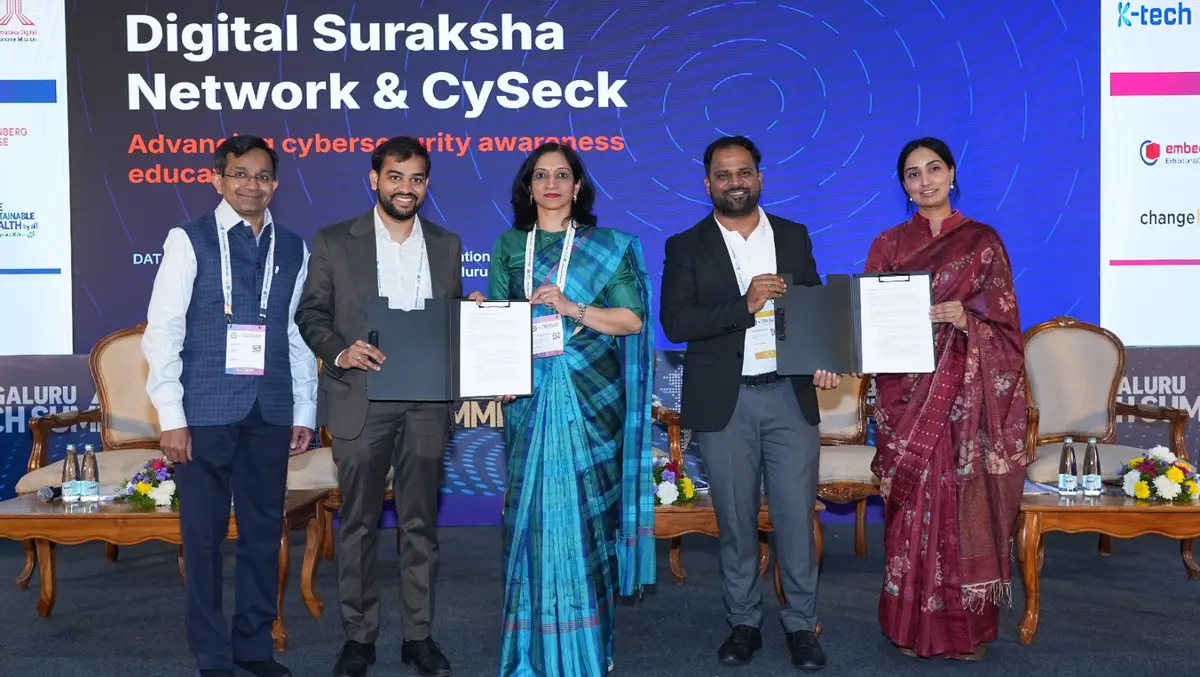
The Centre of Excellence for Cybersecurity and the Digital Suraksha Network Foundation have signed a memorandum of understanding in Bengaluru focused on cybersecurity work in Karnataka.
The partnership brings together CySecK, a Karnataka government initiative, and DSN, a non-profit network launched by CoinDCX co-founders in March 2026. They will work on skills development, public awareness and support for the state's wider cybersecurity network.
A central goal is a Kannada-language cyber safety campaign aimed at reaching 1 crore people across Karnataka by 2027. The collaboration also covers training resources, faculty input and curriculum support for CySecK programmes, as well as mentorship and industry exposure for students and cybersecurity start-ups linked to the initiative.
The memorandum was signed in the presence of Dr Manjula N, Secretary, Department of IT, BT and S&T, Government of Karnataka, and Sumit Gupta, Co-Founder, CoinDCX. CySecK was established in 2017 and is based at the Indian Institute of Science in Bengaluru, with support from the Foundation for Science, Innovation and Development.
Public-private model
The agreement reflects a broader push for public-private cooperation to tackle online fraud, particularly as digital payments and online financial activity expand across India. The organisations pointed to rising fraud volumes and the difficulty of tracking scams that move across platforms, payment systems and asset classes.
According to the National Cyber Crime Reporting Portal, more than 65,89,201 financial fraud complaints were registered between 2021 and 2025, with reported losses exceeding ₹55,050 crore. Those figures underscore efforts by state bodies, educational institutions and private sector groups to expand cyber awareness and improve training for officials and students.
For Karnataka, the collaboration is intended to bring policy, teaching and operational experience closer together. The plan includes practitioner-led learning for students and officers, drawing on people working directly on fraud issues.
Dr Manjula N set out the state's view of that approach.
"I wholeheartedly appreciate the role of private companies in strengthening the cybersecurity ecosystem. Public-private partnerships play a vital role in bringing together the strengths and expertise of different stakeholders to address emerging challenges. We are happy to partner with DSN in this important endeavour to strengthen digital safety and protect citizens from cyber fraud," said Dr Manjula N, Secretary, Department of IT, BT and S&T, Government of Karnataka.
Awareness and training
The citizen awareness element focuses on Kannada-language messaging, suggesting the programme will rely on local-language communication rather than English-only campaigns. That outreach goal sits alongside more institution-focused work on training materials and expert support for CySecK activities.
DSN describes itself as an independent, non-profit platform focused on digital financial fraud in India. It is funded by CoinDCX and works across research, technology solutions, capacity building and advocacy, according to background information released with the announcement.
Sumit Gupta said the agreement could help connect government, academia, industry and civil society in a shared response to fraud.
"We are proud to partner with the Government of Karnataka through CySecK. Cyber fraud is growing more complex every day. It calls for government, industry, academia and civil society to join hands to drive education, build stronger defences and give every citizen the tools to stay safe. Through DSN, we hope to add value to Karnataka's efforts and build something that can be a model for the rest of India," said Sumit Gupta, Co-Founder, CoinDCX.
The ecosystem support strand is aimed at students and cybersecurity start-ups within CySecK's network. Under the arrangement, they will receive mentorship and exposure to industry settings, including opportunities to test solutions in live operating environments.
That may be significant for Karnataka, which has sought to deepen links between academic research, early-stage companies and government-backed technology programmes. CySecK has positioned itself as a platform for those connections, bringing together government, academia, industry and start-ups around cybersecurity work.
Shivaling Salakki, Program Director at CySecK, said the partnership could show how cooperation between public institutions and private organisations can widen the reach of digital safety work.
"This MOU or collaboration, we hope, will be an example in the coming years of how public-private partnership can amplify efforts and results for a common cause. This one, especially focused on securing the digital safety of citizens, surely is the need of the hour. And we at CySecK are excited for this partnership," said Salakki.