


Fraud prevention for hospitality leaders: Tackling hotel booking fraud
Wed, 29th Jul 2026
Hotels lose far more than room revenue to fake bookings. Fraudulent reservations distort occupancy forecasts, increase chargeback costs, waste front desk resources, and can even prevent genuine guests from securing available rooms. While many hospitality fraud strategies focus on AI-driven risk scoring or identity verification at check in, much of this fraud can be detected much earlier by verifying the address, email address, phone number, and identity information guests provide during booking.
Contact data is often the first thing a booking engine collects and the last thing hotels verify. That gap is where much of today's hotel booking fraud, chargeback disputes, and synthetic identity fraud slips through. It is also where some of the most effective hotel fraud prevention measures begin.
Where Fake Bookings Often Start
Fraudulent reservations often share subtle warning signs, a disposable email address that will never receive a booking confirmation, a phone number tied to a virtual line rather than a genuine mobile carrier, or a billing address that does not match the payment card or does not exist at all. These indicators do not require facial recognition or sophisticated behavioural analytics to detect. They can be verified in real time using the same contact details every booking engine already collects.
One growing challenge for hotels is synthetic identity fraud, where criminals combine genuine and fabricated personal information to create identities that appear legitimate. These identities may be used to make fraudulent reservations, create loyalty programme accounts, or exploit promotional offers. While no single verification method can detect every synthetic identity, validating contact data and identity information provides an effective first layer of defence before payment or check in.
Address Verification: Catching Bookings Built on Nowhere
Some fraudulent bookings are created solely to generate a confirmation document rather than an actual hotel stay. Examples include commission abuse, reservation fraud used to obtain booking confirmations for visa or travel documentation, and payment fraud involving stolen card credentials.
In these situations, the address associated with the booking is often incomplete, mismatched, or entirely fabricated. Address verification checks a guest's address against authoritative postal data in real time, confirming that it exists, is correctly formatted, and is deliverable. This gives hotels an early indication that a reservation may require additional review before inventory is committed.
Address verification also strengthens payment fraud prevention. When a billing address does not match the guest's stated address or falls outside the normal profile of a legitimate cardholder, that discrepancy becomes another valuable fraud signal. For hotels processing card payments, validated billing addresses can also improve Address Verification Service (AVS) matching during payment authorisation, helping reduce fraudulent transactions and chargebacks.
For international hotel groups, verifying addresses across more than 250 countries and territories helps maintain consistent fraud controls regardless of where bookings originate.
Email Verification: Stopping Bookings That Were Never Meant to Be Confirmed
A genuine guest wants to receive their booking confirmation. A fraudulent booking often has no interest in whether that confirmation ever arrives because the reservation was never intended to result in a stay.
Email verification identifies disposable and temporary email domains, detects invalid syntax or non-existent mail servers, and distinguishes a monitored inbox from a throwaway account created for a single transaction. Disposable email addresses are frequently associated with fraudulent registrations because they allow bad actors to create accounts without maintaining a long-term identity.
Running email verification during the booking process allows hotels to identify suspicious reservations before confirmation, reducing manual investigation later and preventing fraudulent bookings from progressing through the reservation system.
Phone Verification: Separating Real Guests from Disposable Numbers
Phone verification provides another independent layer of fraud detection. It confirms whether a number is active, identifies the line type, such as mobile, landline, or VoIP, and flags numbers associated with virtual or disposable services commonly used to avoid identity checks.
It can also identify the country and carrier associated with the number, helping hotels detect inconsistencies between the booking location, payment information, and the guest's contact details.
A genuine traveller typically provides a mobile number they can be contacted on before arrival. Fraudulent reservations are far more likely to rely on virtual numbers that provide little confidence the guest can actually be reached. When combined with address, email, and phone verification, phone verification gives hotels a much clearer picture of which reservations can be confirmed automatically and which require further review.
Digital Identity Verification: Confirming the Guest Behind the Booking
Address, email, and phone verification confirm that the contact details supplied during booking are genuine. Digital identity verification goes one step further by confirming that the person behind those details is who they claim to be.
This is particularly valuable for higher risk reservations, such as last-minute bookings, luxury accommodation, long term stays, or reservations originating from channels with elevated fraud rates.
Digital identity verification can verify whether the supplied identity belongs to a real individual by comparing customer information against trusted reference data and authoritative sources. It also helps detect synthetic identities, identity theft, and inconsistencies that may indicate fraudulent activity.
When combined with address, email, and phone verification, identity verification creates a layered approach to hotel fraud prevention, helping hotels establish confidence in every reservation before a room, rate, payment, or loyalty reward is committed.
Building a Layered Hotel Fraud Prevention Strategy
Fraud prevention is most effective when multiple verification layers work together throughout the guest journey.
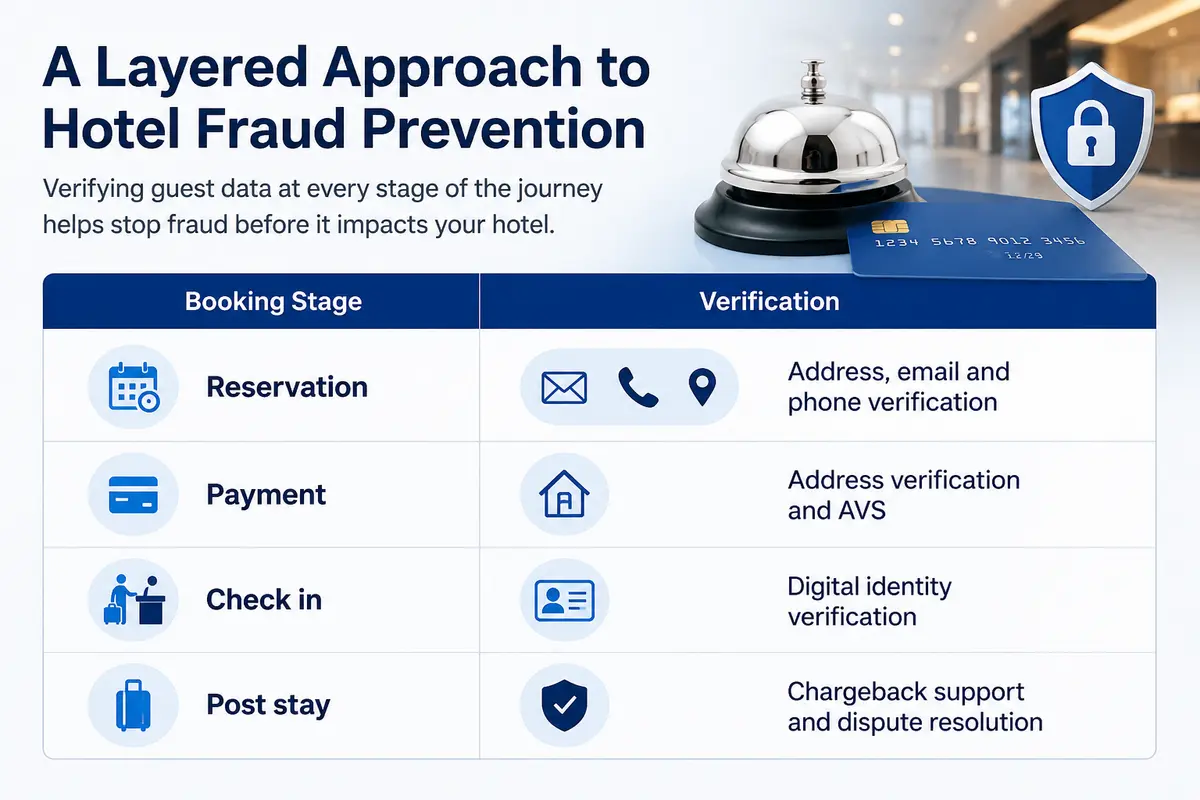
Hotels that only verify identity during check in are often detecting fraud after a room has already been reserved, staff time has already been invested, and legitimate guests may already have been turned away because inventory appeared unavailable.
Protecting Loyalty Programmes as Well as Bookings
Loyalty programmes are increasingly attractive targets for fraudsters. Criminals frequently create multiple accounts using slight variations of addresses, disposable email accounts, and virtual phone numbers to exploit promotional offers or redeem stolen reward points.
Verifying and standardising customer contact data helps identify duplicate accounts before fraud occurs, protecting programme integrity while safeguarding the guests whose rewards are at risk.
Why This Matters More as Booking Volume Grows
As direct bookings and third-party travel platforms continue to expand, hotels collect more customer data than ever before. Manual fraud reviews cannot scale efficiently, while rules based systems alone often either miss sophisticated fraud or incorrectly flag legitimate guests, creating unnecessary friction during the booking process.
Automated address, email, phone, and identity verification solve both challenges simultaneously. They identify meaningful fraud signals in real time while allowing legitimate guests to complete reservations quickly and without unnecessary delays.
Fraud prevention in hospitality does not begin at check in. It begins the moment a reservation is made. By verifying address, email, phone, and identity information during the booking process, hotels can stop fraudulent reservations earlier, reduce chargebacks, protect loyalty programmes, improve operational efficiency, and deliver a smoother experience for genuine guests.
If your hotel or hospitality business wants to reduce hotel booking fraud and improve reservation accuracy, explore Melissa's Identity Verification, Email Verification, Phone Verification and Address Verification solutions to see how they can strengthen your booking workflow while delivering a better guest experience.