


AI traffic on Fastly network grows 30% in five months
Fri, 12th Jun 2026
Fastly has published research showing that AI-generated traffic on its network grew about 30% between January and May 2026, about 6.5 times faster than human traffic over the same period.
The findings suggest a shift in the mix of internet activity, with AI assistants, crawlers, fetchers and agents accounting for a growing share of requests across digital services. This traffic behaves differently from human browsing and places heavier demands on underlying infrastructure.
According to the analysis, 51% of AI requests required direct access to origin infrastructure in May, compared with less than 9% of human traffic. That matters because origin requests are typically more expensive and can put more strain on websites, applications and application programming interfaces.
The research distinguished between AI crawlers and AI fetchers. Crawlers gather information from the web to build and refresh AI models, while fetchers retrieve information in response to user prompts in AI assistants and other software agents.
Those categories are becoming more important as businesses decide whether to allow automated systems to access their content, restrict them, or apply different rules depending on the source and purpose of the request. Those choices can affect visibility in AI-driven search, discovery and commerce.
Fastly's data also showed sharp growth in traffic linked to Anthropic's Claude, with Claude-related requests up more than 555% from a January 2026 baseline. The increase was one of the clearest examples in the study of how quickly individual AI services can alter traffic patterns across the web.
Traffic shift
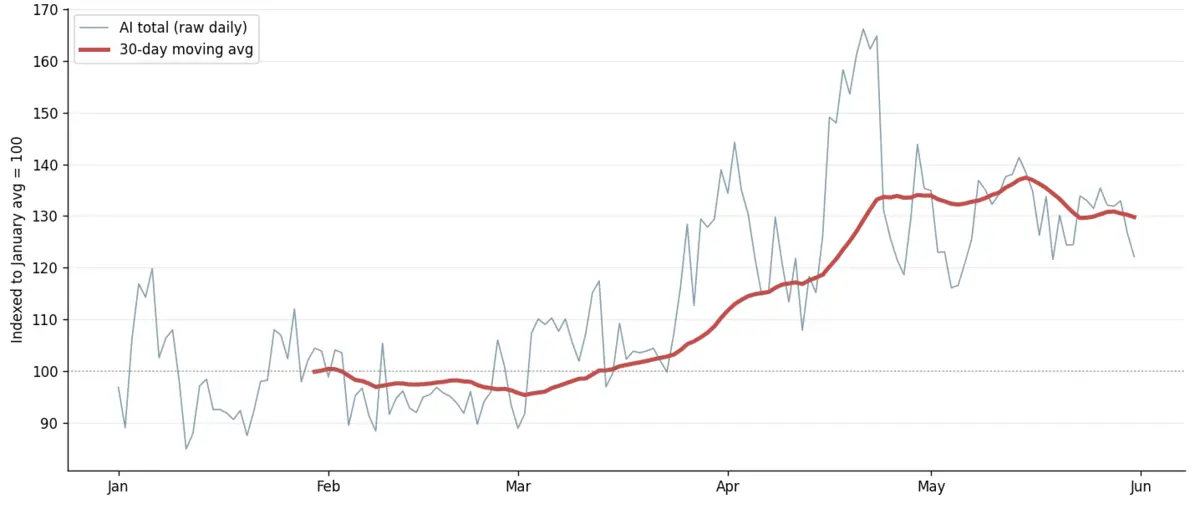
Machine traffic now extends beyond conventional bots used for scraping or abuse. Fastly described a broader class of automated activity that includes AI crawlers, AI fetchers, bots, agents and API-driven systems, each with different patterns and infrastructure demands.
That distinction is likely to matter for publishers, retailers and online service providers, which have traditionally treated non-human traffic mainly as a security or abuse issue. The research suggests some companies are increasingly viewing certain forms of machine access as a commercial and distribution question as well.
Fastly cited examples from its network to illustrate the divergence in responses. In one case, a large company imposed a hard block after a sudden surge in AI fetcher traffic, most likely to preserve control over content. In another, a large company chose not to block AI agents, and fetcher traffic rose over several months.
The contrast underlines a broader tension facing website operators. Restricting AI systems may reduce infrastructure load and limit unauthorised reuse of material, while allowing access may improve the chances that content is surfaced by AI tools that increasingly mediate how users find information, products and services.
Artur Bergman, Chief Technology Officer at Fastly, said the shift is changing how organisations need to think about internet traffic.
"AI traffic is fundamentally changing how the internet operates," Bergman said.
"Businesses are moving beyond a world where humans are the primary users of digital experiences. The challenge is no longer simply blocking bots; it is understanding which machine interactions should be accelerated, managed, challenged or stopped," he added.
Business choices
The data adds to a wider debate in the technology and media sectors about how AI systems should access online content and services. For some companies, the issue centres on rising compute and bandwidth costs. For others, the more immediate concern is whether AI assistants become gatekeepers between brands and users.
Fastly argued that managing AI traffic is moving beyond security and network operations into business strategy. Companies need clearer visibility into which automated systems are making requests, more context on how those systems behave, and finer control over how to respond, it said.
That approach reflects the growing complexity of machine traffic. Not every automated request has the same value or risk: some may support search and discovery, some may serve live user queries through AI assistants, and others may extract data without a clear commercial benefit for the site owner.
As AI services become more embedded in search, shopping and customer support, the volume and type of this traffic are likely to remain a focus for infrastructure providers and the companies that rely on them. Fastly's figures suggest the issue is no longer confined to bot mitigation but is becoming part of how organisations manage visibility, cost and control online.
More than half of AI requests on Fastly's network now reach origin systems, compared with less than one in 10 human requests.